
Table of Contents
What’s the Difference for Providers?
If you are delivering disability, community nursing or support services in Australia, understanding the difference between the NDIS and DVA is essential for compliance and sustainable growth.
While both fund support services, they operate under very different regulatory, funding and governance frameworks.
This guide explains:
-
What the NDIS is
-
What DVA covers
-
The key differences between NDIS and DVA
-
Compliance implications for providers
-
Whether you should register for one or both
What is the NDIS?
National Disability Insurance Scheme
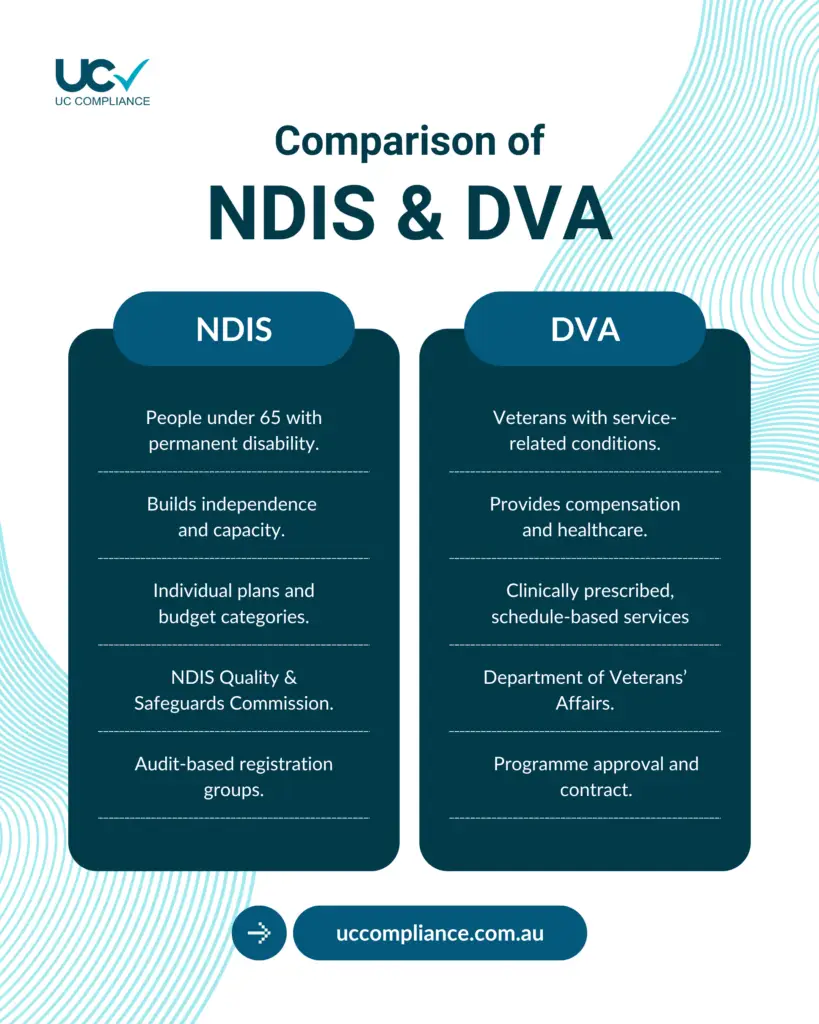
The National Disability Insurance Scheme (NDIS) provides funding to Australians under 65 with a permanent and significant disability.
It is administered by the National Disability Insurance Agency (NDIA) and regulated by the NDIS Quality and Safeguards Commission.
Key Features of the NDIS
-
Individualised participant plans
-
Funding based on “reasonable and necessary” supports
-
Participant choice and control
-
Strict provider registration requirements
-
Mandatory compliance with the NDIS Practice Standards
NDIS providers must undergo audits (verification or certification) and comply with incident management, complaints handling, worker screening and governance obligations.
What is DVA?
The Department of Veterans’ Affairs (DVA) provides compensation and health support to Australian veterans and their families.
DVA funding is linked to service-related health conditions and includes:
-
Community nursing
-
Personal care
-
Allied health
-
Rehabilitation
-
Mental health support
Unlike the NDIS, DVA is not a disability insurance scheme. It is a government compensation and healthcare framework for veterans.
Who They Support
NDIS
Supports individuals under 65 with permanent and significant disabilities, regardless of how the disability occurred.
DVA
Supports veterans and eligible family members with service-related conditions.
Funding Model
NDIS Funding Model
-
Participant-directed budgets
-
Price limits under the NDIS Pricing Arrangements
-
Claims submitted via the NDIS portal
-
Flexible supports within plan categories
DVA Funding Model
-
Clinically prescribed services
-
Schedule-based item numbers
-
Claims processed via Medicare/DVA systems
-
Strict adherence to DVA programme guidelines
Compliance Requirements
NDIS Compliance
-
Registration through the NDIS Commission
-
Mandatory audits
-
Practice Standards compliance
-
Incident reporting within strict timeframes
-
Restrictive practice authorisation requirements (where applicable)
DVA Compliance
-
Approval under specific DVA programmes (e.g. Community Nursing)
-
Clinical documentation requirements
-
Adherence to DVA Guidelines
-
No NDIS Commission audit pathway
Providers often underestimate the documentation standards required under DVA, particularly for nursing and clinical services.
Registration Process
| NDIS | NDIS | |
|---|---|---|
|
Registration group-based model |
Programme approval model |
|
|
Certification or Verification Audit |
Content |
|
The NDIS operates under a registration group-based model. It requires an Audit and is regulated by the NDIS Quality and Safeguards Commission. Providers are subject to ongoing compliance monitoring and formal audit cycles.
In contrast, DVA operates under a programme approval model, typically based on contractual arrangements. It is governed by DVA Guidelines rather than the NDIS Commission. Oversight focuses on clinical documentation standards and periodic review processes rather than audit-based registration.
Can You Deliver Both NDIS and DVA Services?
Yes. Many providers strategically register for both schemes to diversify revenue streams and reduce dependency on a single funding model.
However, this requires:
-
Separate billing systems
-
Clear governance structures
-
Distinct policies and procedures
-
Staff training aligned to both frameworks
Blurring compliance systems between NDIS and DVA can create significant audit risks.
Should You Register for NDIS or DVA?
You may consider:
NDIS Registration if you:
-
Support participants under 65
-
Deliver disability-specific supports
-
Provide SIL, high-intensity or behaviour supports
DVA Approval if you:
-
Deliver community nursing
-
Support veterans
-
Provide service-related rehabilitation
Some organisations choose both to strengthen long-term sustainability.
Final Thoughts: Understanding NDIS vs DVA
The NDIS and DVA are fundamentally different in:
-
Purpose
-
Eligibility
-
Funding structures
-
Compliance obligations
-
Regulatory oversight
Understanding these differences protects your organisation from compliance risk and positions you for strategic growth.
If you are considering NDIS registration, DVA registration, or expanding into both frameworks, ensure your governance systems are built correctly from the outset.
FAQs About Becoming a DVA Provider
What is the main difference between NDIS and DVA?
The NDIS supports people under 65 with permanent and significant disabilities, regardless of how the disability occurred.
DVA supports veterans and eligible family members with service-related health conditions.
Can a provider be registered for both NDIS and DVA?
Yes. Many providers deliver services under both frameworks. However, governance systems, billing processes, documentation and compliance requirements must remain clearly separated.
Does NDIS registration automatically allow you to provide DVA services?
No. NDIS registration does not automatically qualify a provider for DVA approval. DVA has its own programme guidelines, approval pathways and documentation standards.
Are NDIS and DVA audits the same?
No. NDIS providers must undergo Verification or Certification Audits under the NDIS Practice Standards.
DVA providers are subject to programme reviews and clinical oversight rather than NDIS Commission audits.
Support from UC Compliance
We help health providers and small businesses register with DVA, set up compliant systems, and prepare for audits.
📞 Book your free 15-minute consultation today.
📧 info@uccompliance.com.au
🔗 Book a free consult here